VARAH is my solo SCAD capstone. I led the research, reframing, product direction, business model and prototype.
The problem
The wait breaks the luxury.
Factory-order luxury buyers wait 12+ weeks for their car, mostly in silence. Updates are vague, timelines shift without explanation, and dealers are blind until the car clears port. The showroom feels luxury; the wait feels like any regular car.
For whom
Three sides of one wait.
Luxury factory-order buyerPaid for something special and wants to feel it is happening.
Dealer SpecialistOwns the relationship, but lacks data trustworthy enough to share.
OEMOwns production data and the brand promise, with no measurement layer for the wait.
What we designed for
Buyer satisfaction during the waitHow the brand feels between order and handover.
Cancellation rate vs. baselineFewer buyers walking away before delivery.
Specialist response timeHow quickly a real person answers.
Translation accuracyStatus codes turned into milestones buyers understand.
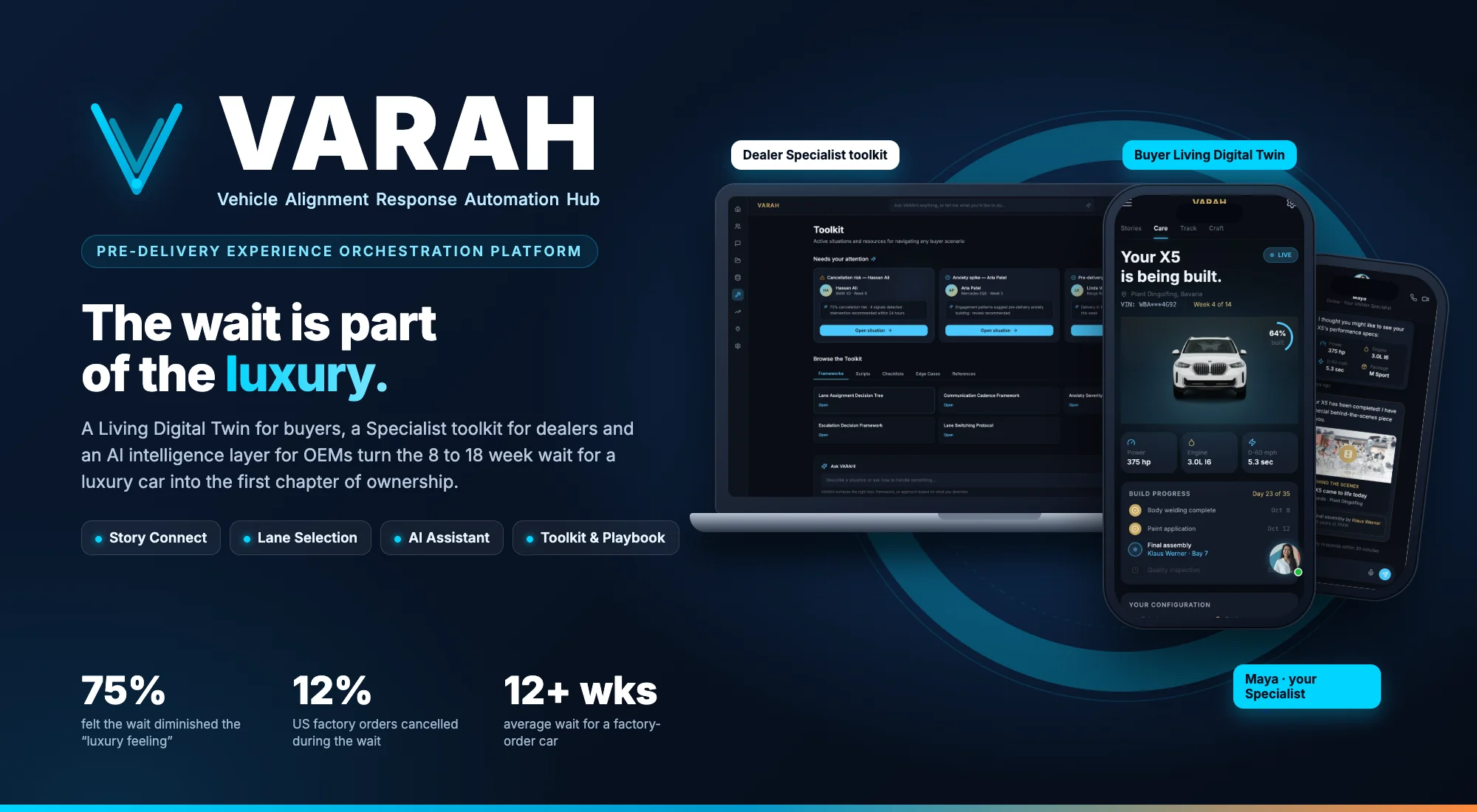
75%of buyers said the wait diminished the luxury feeling
12%of US factory orders cancel during the wait
12+ wksaverage wait for a factory-order car
20-ptCSAT variance across OEM dealer networks
Research and market figures from the VARAH business case.
02 / VARAH
From port delays to buyer trust
The project began with communication gaps around Savannah Port. That framing made access to port operations a dependency and placed the problem outside the experience I could meaningfully observe and influence.
Old focus
Investigate how communication gaps at Savannah Port influence delays in luxury vehicle delivery, and improve port-to-dealer information flow.
New focus
Design a system that manages delivery uncertainty by translating operational variability into structured decisions and customer experience across the waiting phase.
The decision: change the unit of design.
Faculty feedback showed the luxury value was breaking down between the dealership and the buyer, not at the port. I reframed the opportunity around delivery transparency and emotional reassurance.
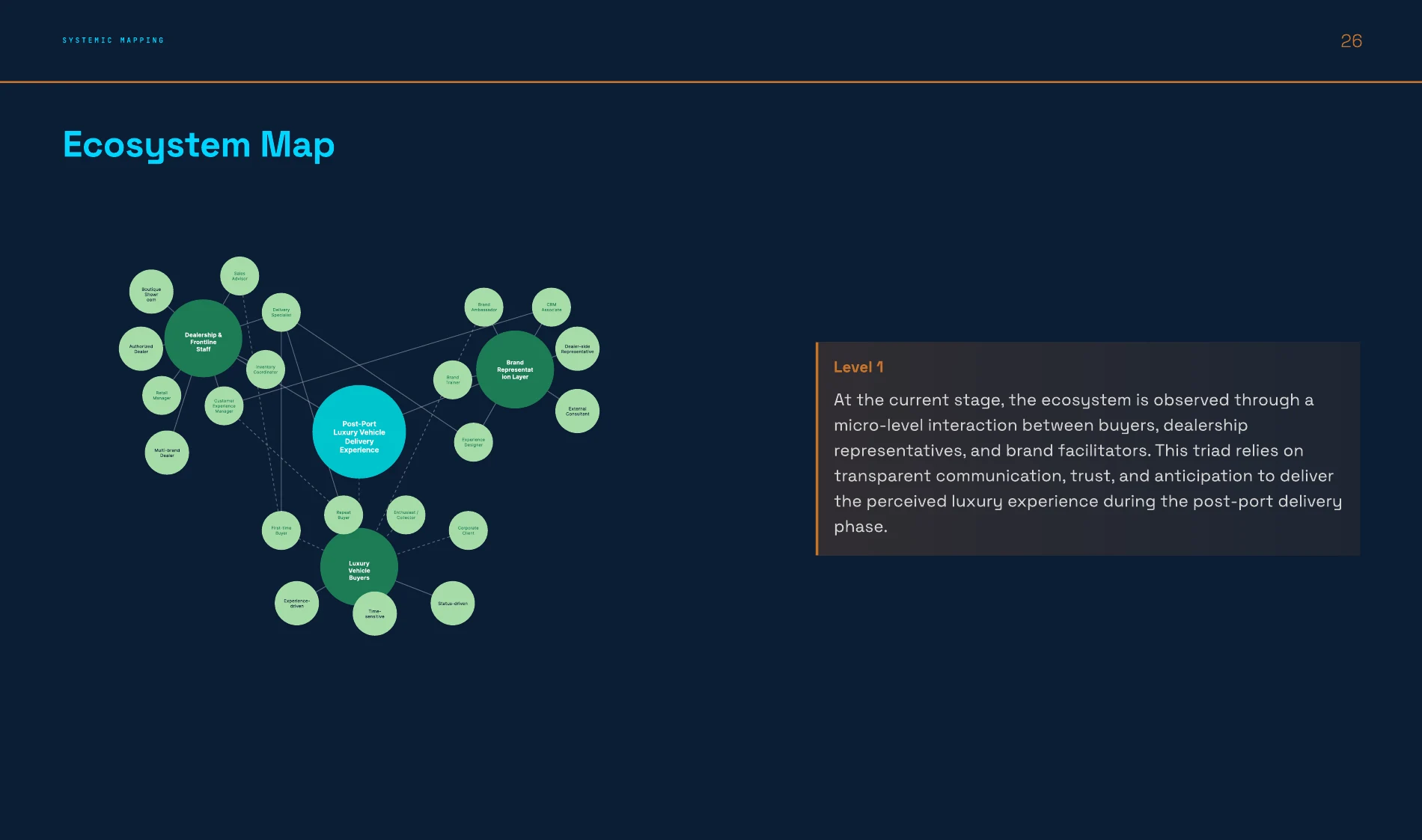
Mapping the organizations and information flows around vehicle delivery Process book · PDF p. 29 · Open image ↗03 / VARAH
What the research changed
Buyer and dealer interviews revealed two sides of the same uncertainty. Buyers wanted a sense that something was happening; dealers wanted information they could trust enough to communicate. More status codes would not resolve either need.
Around week five. I had no clue what was happening.
Buyer
We have no idea until it clears the port.
Dealer
The showroom felt luxury, but the wait felt like any regular car.
Buyer
Insight → product decision
Translate operational codes into understandable milestones. Pair those milestones with a recognizable person who owns the relationship, instead of making the buyer interpret logistics data.
I extended the research with Thinkertoys activities including Slice and Dice, SCAMPER, False Faces and cross-industry analogies, and ran hybrid co-creation sessions that paired real buyers and dealers with synthetic personas to widen the range of ideas.
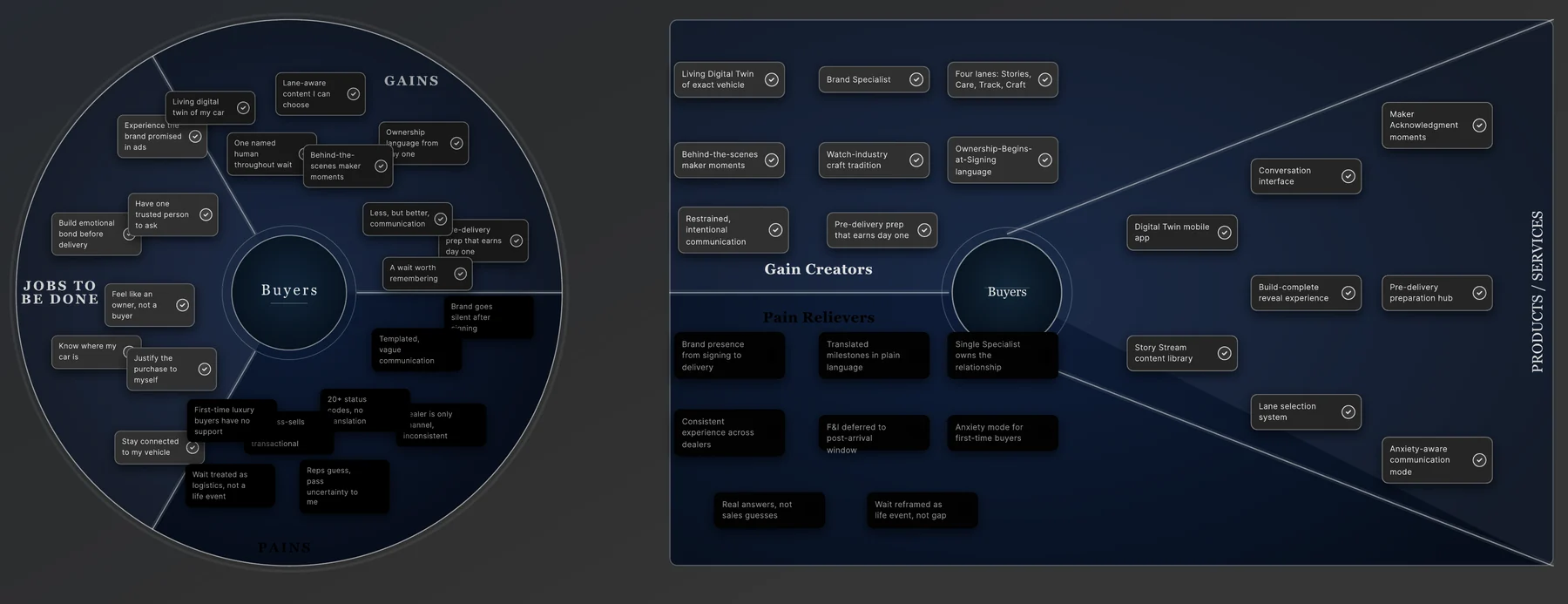
Co-creation wheel · Buyers
123
The buyer wheelJobs to be done, gains and pains from co-creation, with the buyer at the hub.
The value mapGain creators and pain relievers answer each segment of the wheel.
What we builtDigital Twin app, Story Stream, a single Specialist and translated milestones.
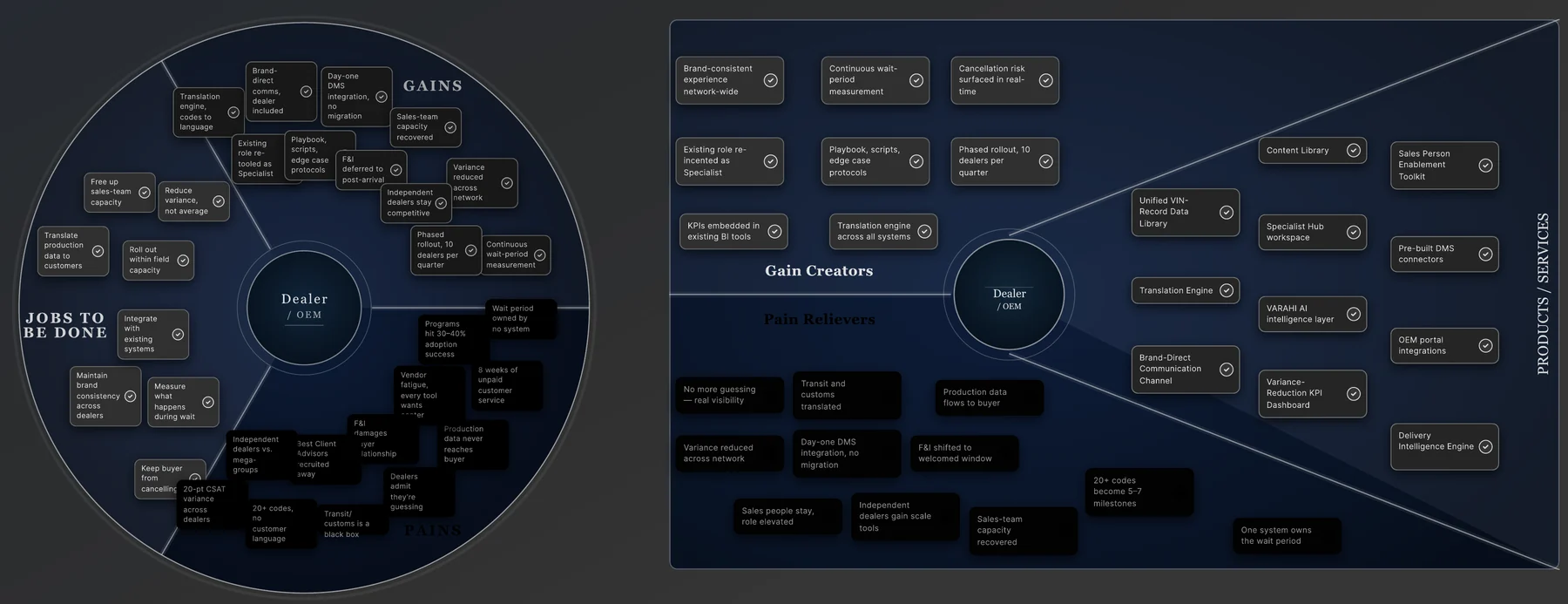
The buyer synthesis pointed toward intentional presence: one named Specialist, a living representation of the vehicle, and content chosen through Stories, Care, Track and Craft. The dealer synthesis pointed toward a translation layer and integrations with existing systems, rather than another replacement tool.
Co-creation wheel · Dealer / OEM
123
The dealer and OEM wheelCapacity, variance and integration needs, with the dealer and OEM at the hub.
The value mapExisting roles re-tooled, playbooks, phased rollout and KPIs in current BI tools.
What we builtTranslation engine, unified VIN record, Specialist hub and pre-built DMS connectors.
04 / VARAH
Less tracking. More reassurance.
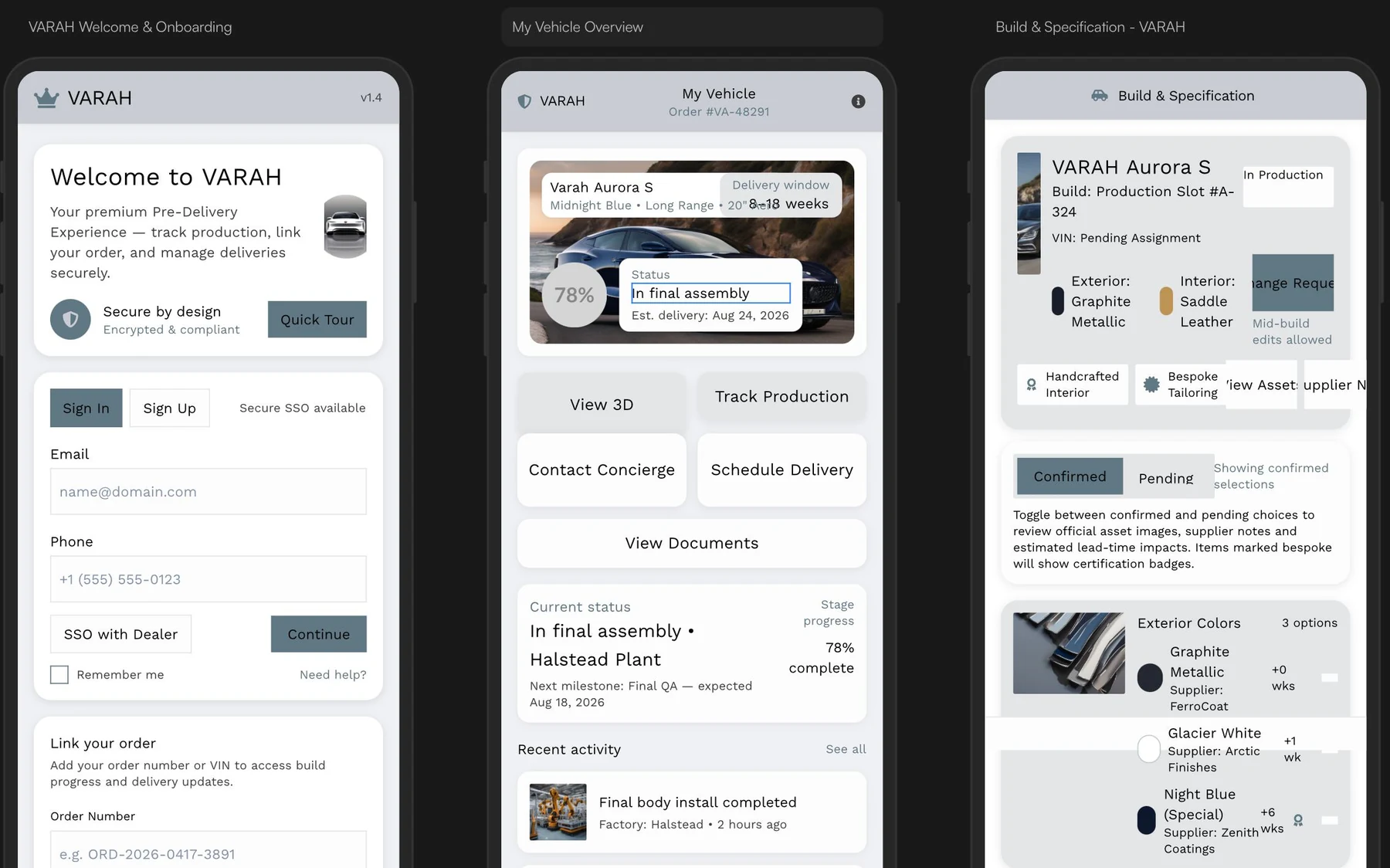
The first concepts treated the wait like a logistics tracker, with progress and operational detail doing most of the work. Testing showed buyers wanted calm over detail, story over status and reassurance over raw transparency.
Before · Tracker concept
1234
Setup firstSign in and link an order before anything reassuring.
Progress as a numberA percentage and a status label to interpret.
Equal buttonsSix functions compete for the same attention.
Logistics detailSupplier notes and lead-time deltas.
After · Reassurance
123
456
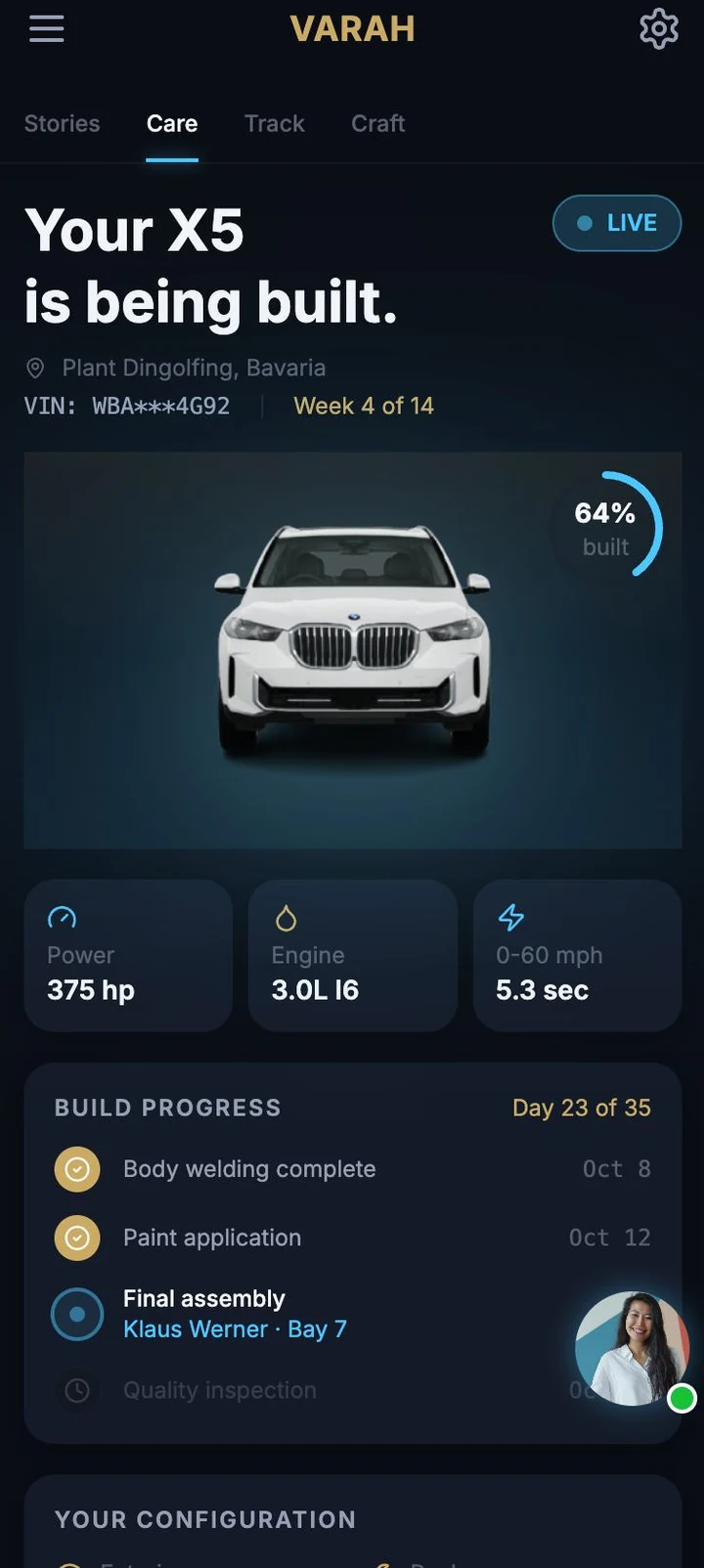
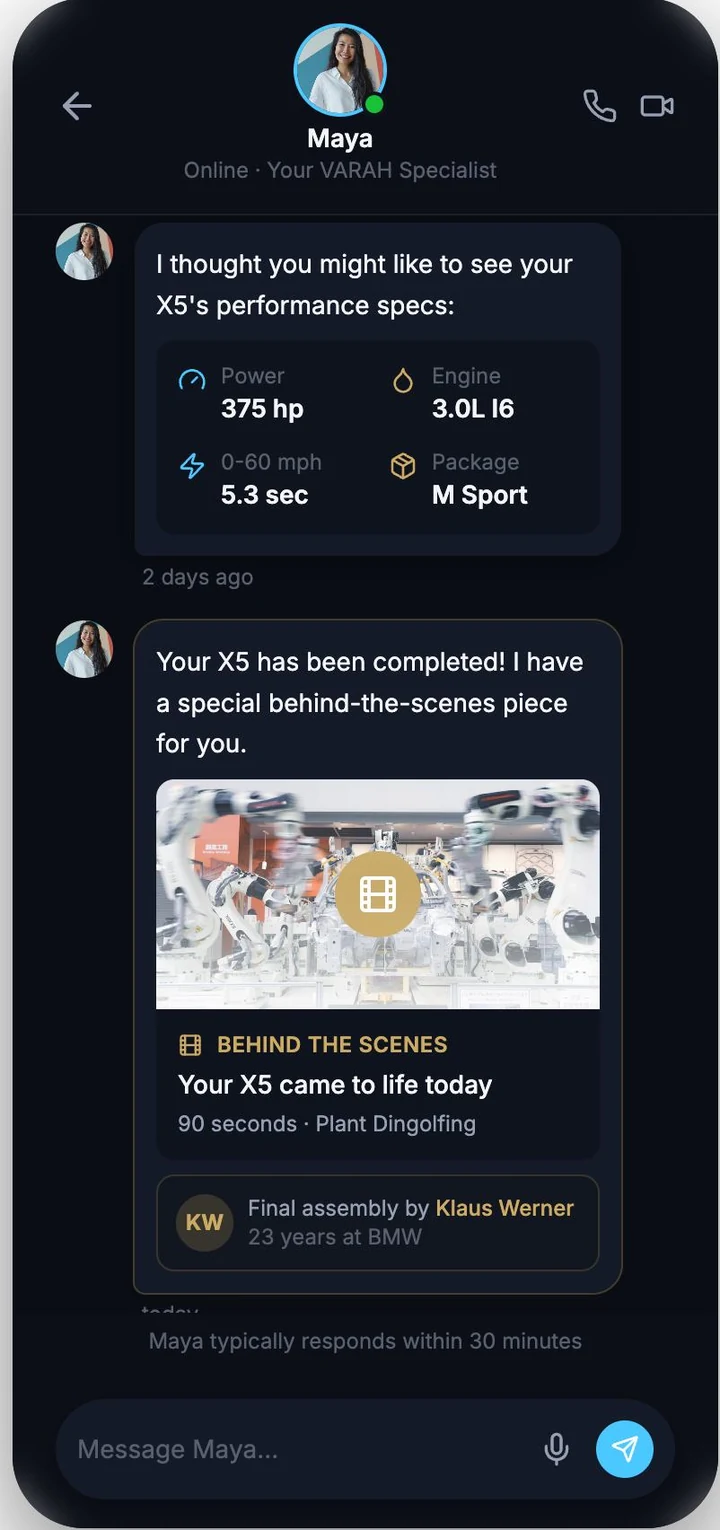
Four lanesStories, Care, Track, Craft: the buyer picks what to see.
Live Digital TwinTheir own car, visibly taking shape.
One named SpecialistMaya is always one tap away.
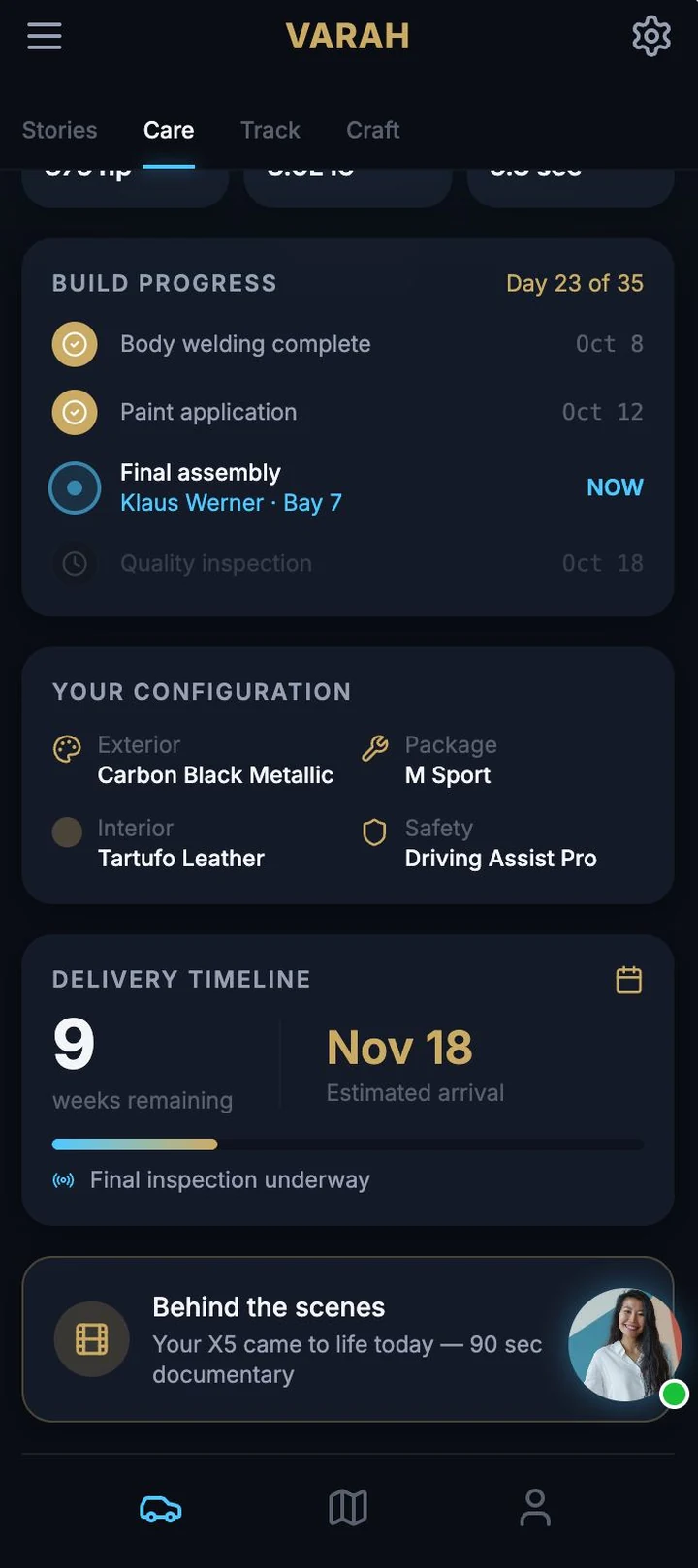
Human milestonesEach step names who is building the car.
Countdown to arrivalWeeks remaining, not status codes.
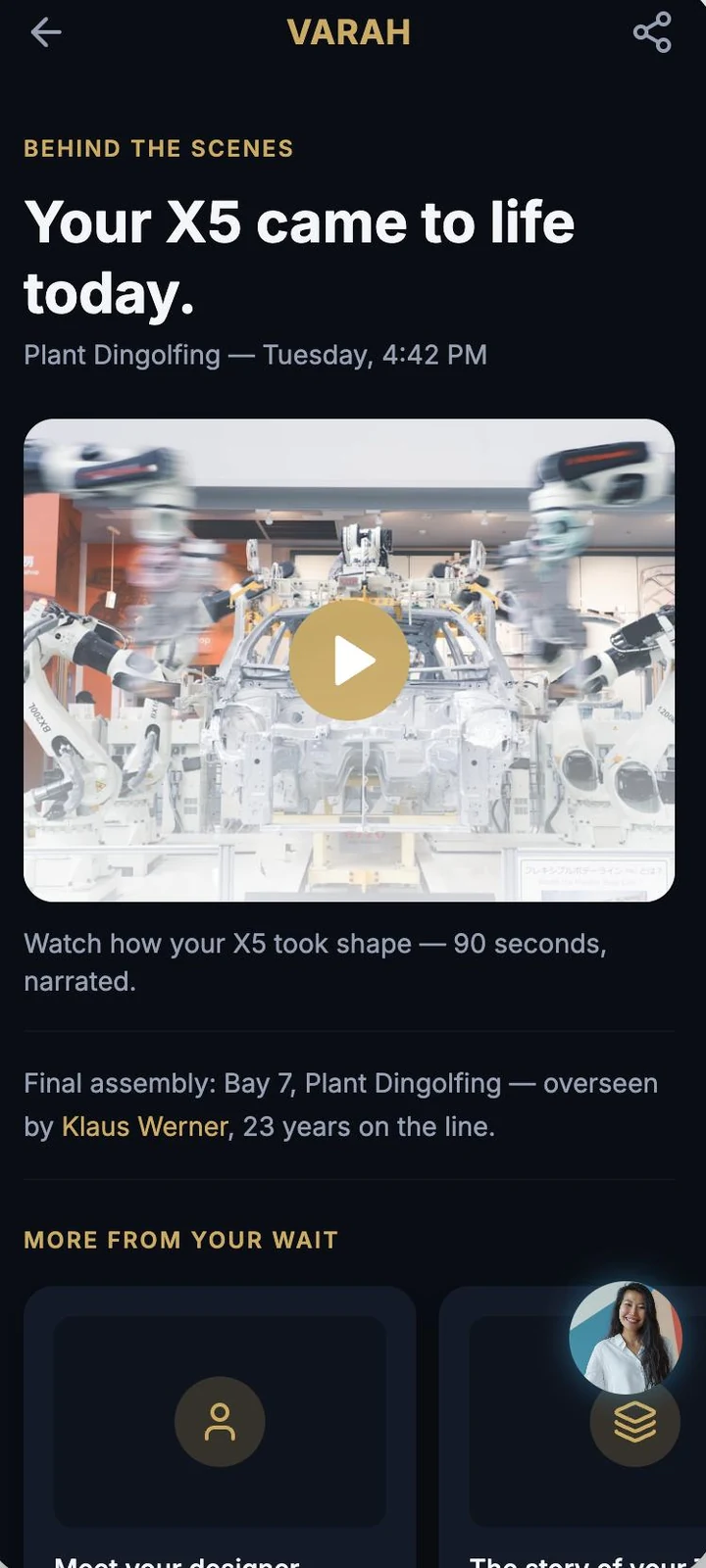
Story StreamA behind-the-scenes moment at the right milestone.
Decision: keep progress visible, but let story and a real person lead.
The VARAH steering-wheel framework
Steer the wait, don’t just track it.
The experience is organised like a steering wheel: control sits at the hub, and five qualities hold it in place.
ControlAt the centre: the buyer feels in control of the wait.
TrustStatus they can believe, translated from production data.
AssuranceOne named Specialist who answers.
ConfidenceMilestones in plain language instead of codes.
ContinuityOne relationship from signing to delivery.
Emotional connectionStory content about their own car, from the plant floor.
Story Stream and the Specialist
The design also moves finance and insurance cross-selling out of the waiting period. That decision protects the feeling of being welcomed into ownership.
05 / VARAH
Design the service behind the screen
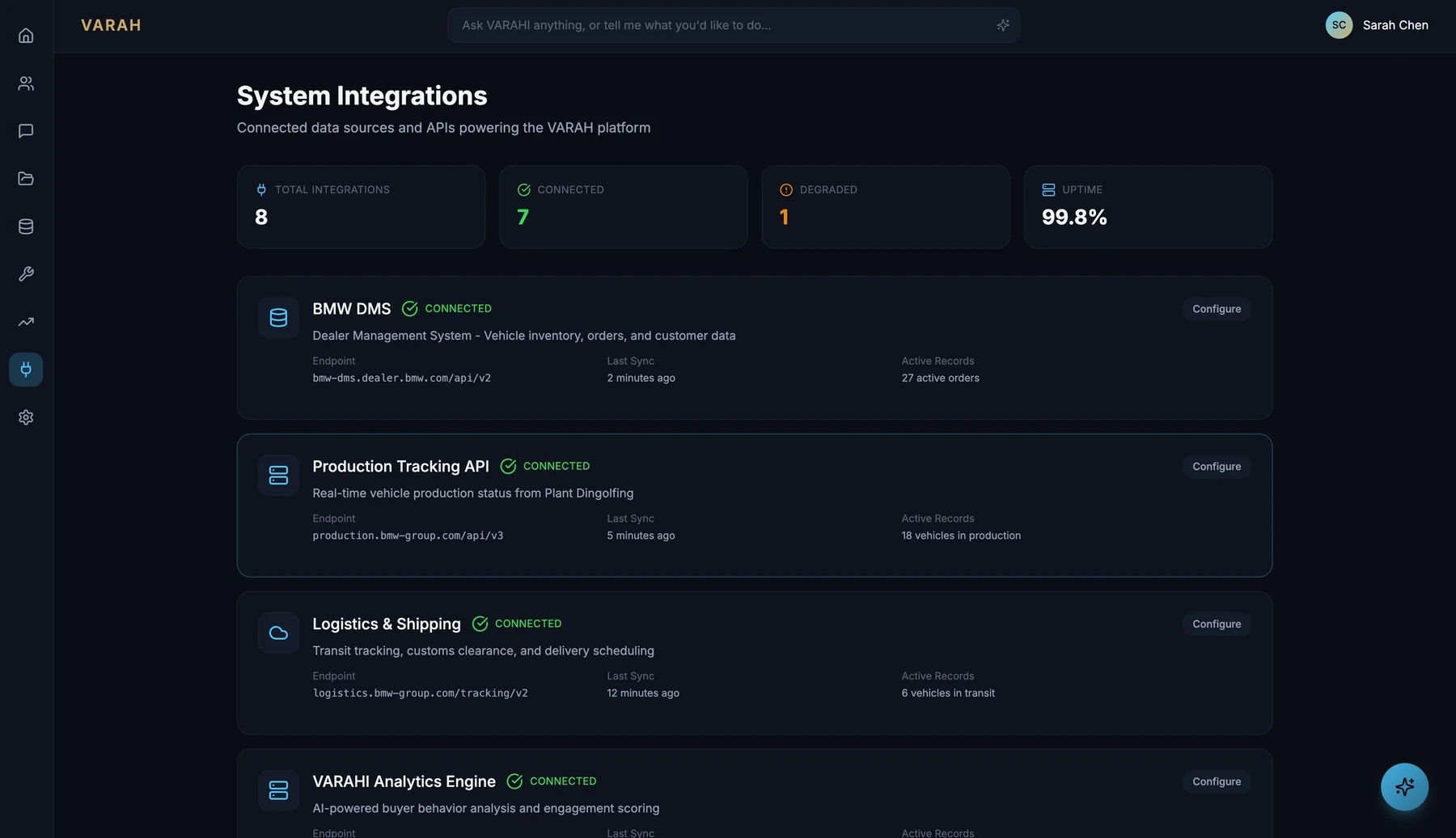
The buyer experience depends on a credible operating model. VARAH defines a unified VIN record, a translation engine and connections to dealer-management and OEM systems: the integration requirements a pilot would build on.
Dealer workspace · Integrations
1234
Integration healthConnected, degraded and uptime at a glance.
Dealer management systemConnected, not replaced.
Production trackingLive build status straight from the plant.
Logistics & shippingTransit, customs and delivery scheduling.
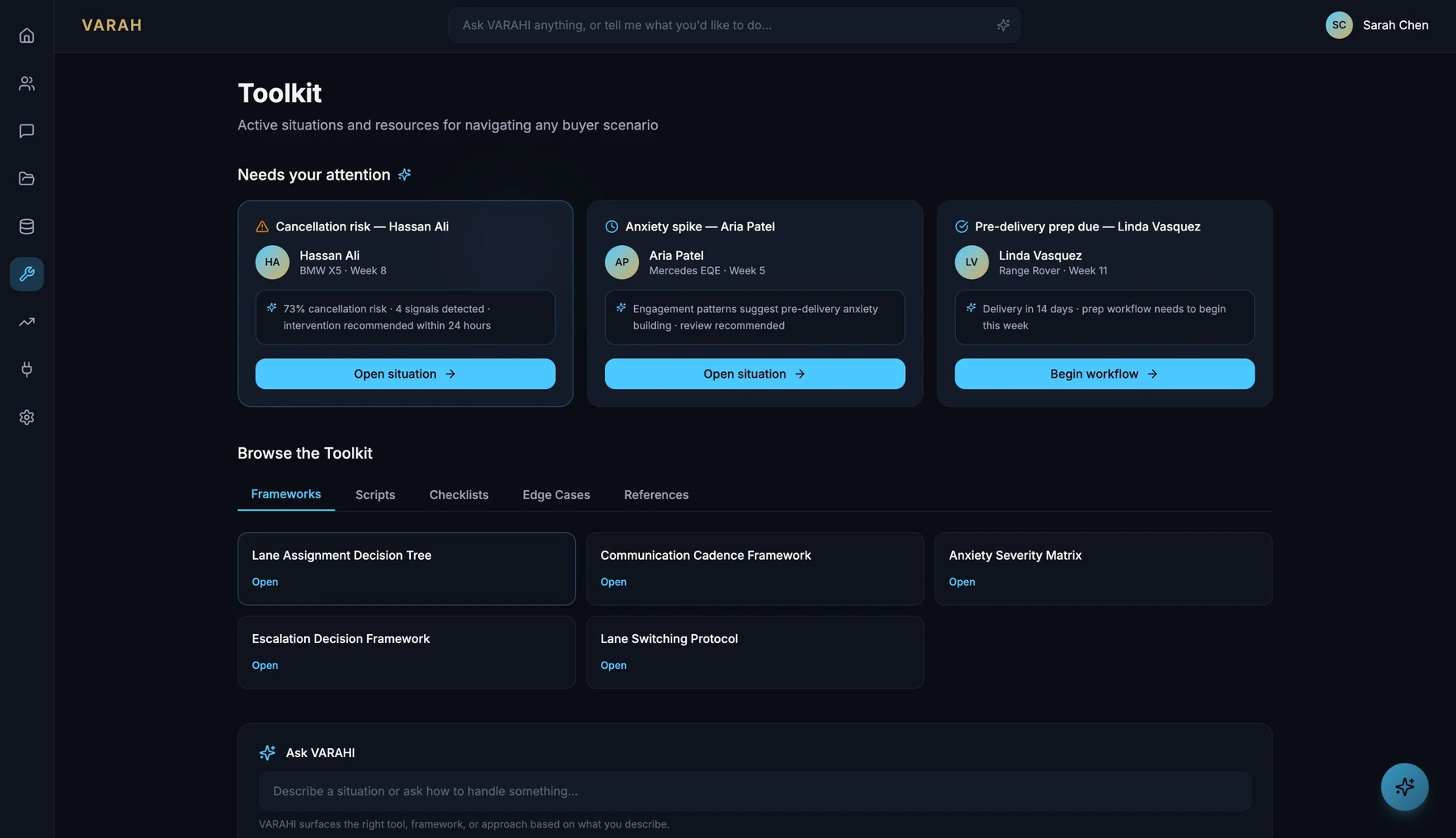
The dealer workspace supports the existing salesperson in a Specialist role. Playbooks and an AI assistant help with exceptions; a cancellation-risk view brings attention to cases that may need human intervention.
Specialist toolkit
12345
Cancellation riskFlagged early, with the signals behind it.
Anxiety spikeSpotted from engagement patterns.
Prep duePre-delivery workflows start on time.
PlaybooksFrameworks, scripts, checklists and edge cases.
Ask VARAHIDescribe a situation, get the right approach.
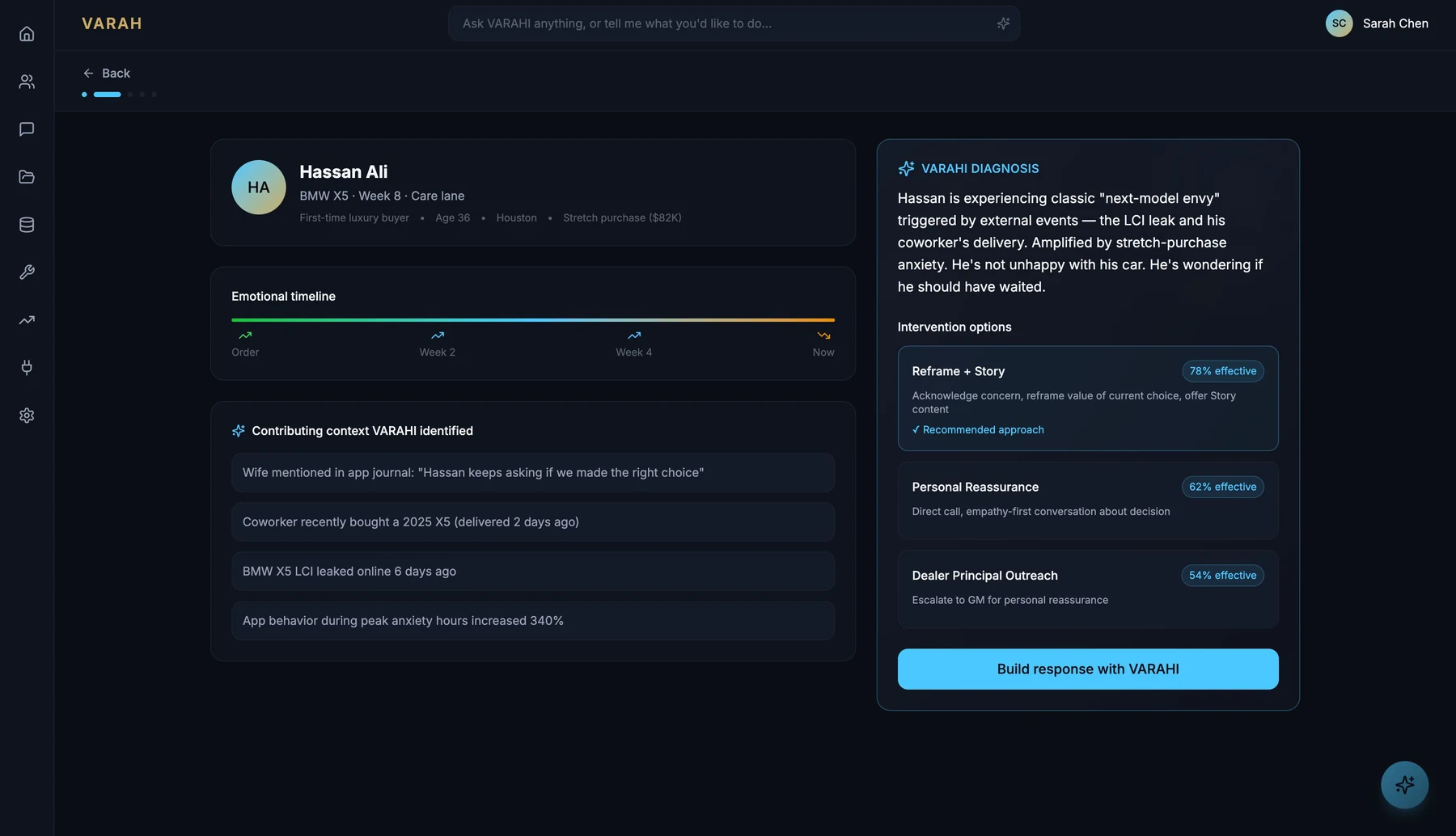
Cancellation-risk handling
123456
Who, and where they areCar, week and lane at a glance.
Emotional timelineHow the buyer’s mood moved from order to now.
Contributing contextThe signals the AI connected.
Plain-language diagnosisWhy this buyer is wavering.
Ranked interventionsOptions ordered by expected effect.
Build the responseDraft the outreach with VARAHI.
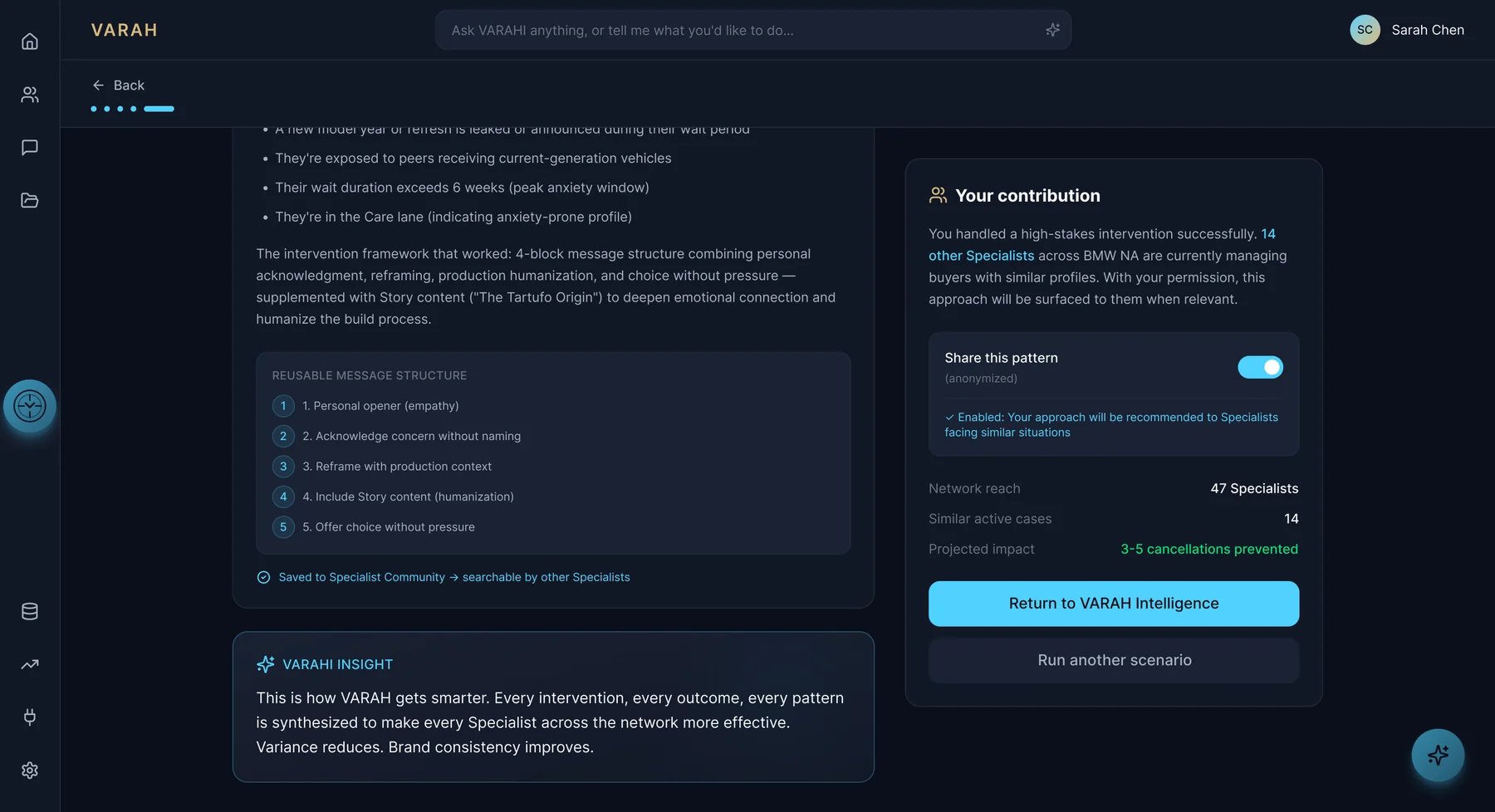
Every resolved case makes the network smarter. When a Specialist closes an intervention, VARAH Intelligence captures what worked and offers it to every Specialist facing a similar buyer.
After a case resolves · VARAH Intelligence learns
12345
Reusable message structureThe five-step intervention that worked is captured: empathy, acknowledgement, reframing, Story content, choice without pressure.
Saved to the Specialist CommunityThe resolved case becomes searchable by other Specialists.
VARAHI insightEvery intervention, outcome and pattern is synthesised, so variance reduces and brand consistency improves.
Share this patternWith the Specialist’s permission, the approach is shared anonymised with others facing similar buyers.
Network reach and projected impact47 Specialists reached, 14 similar active cases, 3–5 cancellations projected to be prevented.
06 / VARAH
Outcome & success metrics
Buyer + dealer prototypeBusiness modelPilot plan
The outcome is a three-sided product concept, buyer and dealer interface designs, a business model and a pilot plan. A balanced scorecard defines how the pilot will be judged.
Business6 metrics
OEM master agreements signed
Active VINs on platform
Dealer rooftop subscriptions
Per-VIN revenue contribution
F&I attach lift, post-arrival
Cancellation revenue protected
Customers7 metrics
Buyer CSAT during the wait
Buyer NPS at delivery
Cancellation rate vs. baseline
Dealer CSAT variance
First-time buyer retention
Engagement quality with Maya
Lane participation rate
Internal processes7 metrics
Data ingestion uptime
Translation engine accuracy
Status code to milestone speed
Specialist response time
DMS integration health
Content delivery cadence
Cancellation risk detection
Growth7 metrics
Specialist certification levels
VARAHI pattern library growth
New Media Library content
Edge-case playbook coverage
Specialist best-practice sharing
Cross-OEM feature adoption
Insight-to-improvement cycle time
VARAHBalanced scorecard
The central lesson is that visibility only creates value when people can act on it. The most consequential design move was changing the question from “where is the vehicle?” to “how does the brand show up while the buyer waits?”